

A featured contribution from Leadership Perspectives: a curated forum reserved for leaders nominated by our subscribers and vetted by the Construction Tech Review Advisory Board.

BC2RI
How the Cloud is Transforming Healthcare

Dr. SB Bhattacharyya
“From clinical isolation to healthcare connection” would probably be the briefest-possible description of what the Cloud is doing to healthcare. The healthcare-related data that used to remain locked up in static silos is now freely flowing between interoperable systems to help both the individual and the community. The “get connected and stay connected” dream has been transformed into a mantra of the modern society by the creation and upscaling of the Cloud and healthcare has not remained immune to its overwhelming influence.
The Cloud allows most of the server-related work like storage, running applications, high performance computing, etc. to be conducted in purpose-built machines and their outputs delivered to digital devices of varying capabilities that seamlessly connect to them using the Internet and act more as data capture and information display devices.
By shifting the heavy-duty data processing and analysis to be performed in specifically configured machines and while the data capture and display, with some lightweight processing, being performed by other machines, all seamlessly in concert, the Cloud facilitates the creation of a digitally-interconnected 24 x 7 ecosystem.
The Cloud
This term is often used a fancy synonym for “the Internet”. It is wrong. The term ‘Cloud’ refers to the platform for distributed computing, while the term “the Internet” refers to the “network of networks”.
The name “Cloud Computing”, which is a better alternative, is a type of Internet-based computing. Here the Internet is used to deliver different types of computer-related services like server, storage, applications, etc. to connected computers and devices. The various types of Cloud computing services available are ‘software as a service’ (SaaS), ‘platform as a service’ (PaaS), ‘infrastructure as a service’ (IaaS) and ‘mobile backend as a service’ (MBaaS), with private, public and hybrid as the various deployment models.
This has had a profound effect on the way computers, both stand-alone and in a networking environment, function. By running a Cloud-based software or using the various components of a Cloud-based platform or harnessing the Cloud-based infrastructure for all heavy-duty computing or using the Cloud as a mobile backend, the Cloud-based solutions can be used to deliver real power to the digital devices that simply cannot perform on their own.
Cloud-based solutions can be used to deliver real power to the digital devices that simply cannot cater to on their own
The common pooling of the data that these devices generate (data aggregation) helps in permitting a great many number of devices to share them, either in their raw state as data or processed (analysed) state as information.
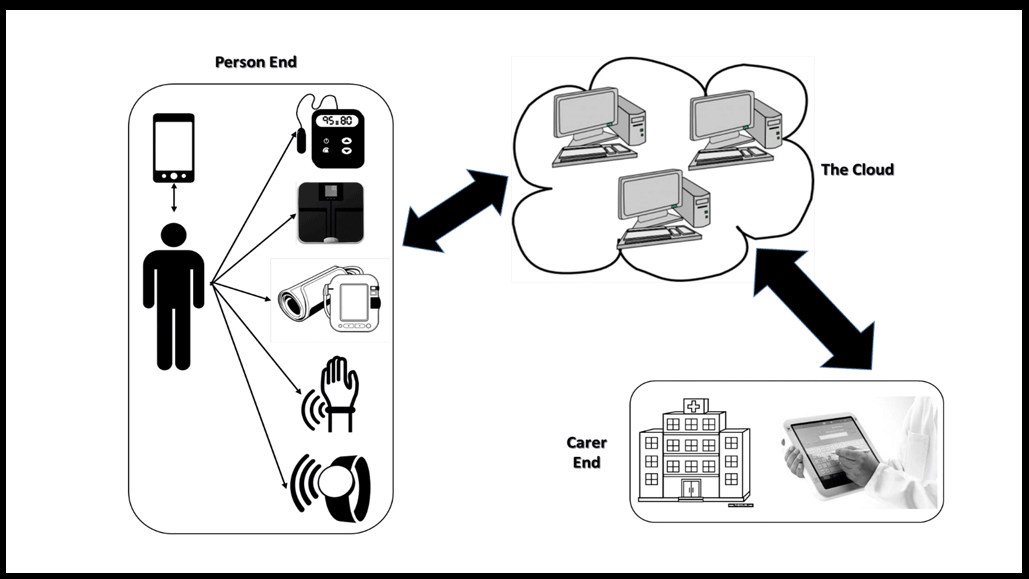
The way the connections are made possible within the healthcare ecosystem is schematically depicted as follows. Various types of medical devices, wearables, and other health-related gadgets at the patient-end are connected to the Cloud, which is in turn connected to various digital health solutions at the provider-end. With data and information flowing from one end to the other 24 x 7 with around 99 percent-plus uptime, continuous connectivity is achieved.
Healthcare Transformation
Healthcare delivery services is undergoing a profound change. It is shifting from being primarily institution-based to increasingly home-based, with prevention and wellness as its primary focus instead of the traditional sick care. There is also an increasing emphasis on individualised care management that is both personalised and precise, rather than the hitherto disease-specific-same-treatment-for-all-approach of traditional care management.
The need to monitor patients and proactively intervene instead of waiting for the patients to visit a provider when they have health-related problems makes the need for having a continuous connection absolutely imperative. The Cloud provides the best sets of tools for this.
From an efficiency and cost-optimisation perspective, it is most important to have a life-long archive of clinical records of a person available at one single place irrespective of whom the person had the clinical encounter with or where a particular investigation had been undergone. While this was always a big challenge in any geography with paper-based records, the Cloud makes this relatively very much possible even for ordinary people in most geographies. Any person can store any of their records in electronic formats in the Cloud and access it from anywhere. This makes it possible for anyone with the privileges to access them for review and care planning for the person, irrespective of who created them.
Conclusion
As a key stakeholder in Web 2.0 and beyond, the Cloud has made information technology accessible to the masses by enabling social media, collaborative work in real-time irrespective of actual physical location and delivery of online services like shopping and telehealth possible. The visible effects of impact of the Cloud on healthcare in general and care delivery in particular are only just beginning. In the coming days and months, its true capabilities will be apparent to one and all as it transforms healthcare enough and beyond, making the dream of Universal Health Coverage, one of the Sustained Developmental Goals of the WHO, a reality. That will definitely be its lasting legacy.
